Outside on the road a dark saloon car is standing, a native chauffeur at the wheel and another native on the footboard. We get in. I am at the back between the two soldiers. The officer and the policeman sit in front with the driver. The native remains hanging on outside as we drive off.
I have been picked up at the rear annexe of the house at Tjiroemstraat 14 where we had found sanctuary with Mrs Kruseman and her married daughter, Elly Reindus. I realise all at once that the sounds we had heard earlier must have been a similar, perhaps the same, party, collecting Howes, another Britisher staying in the main house.
Fortunately, I reflect, Mrs Kruseman and Elly have not appeared and I am thankful that they have thus avoided possible eventual unpleasantness. They will have realised what is going on and have very sensibly lain doggo.
The car turns surprisingly to the left, down towards Tjibeuning - Plantsoen (local Public Gardens), and stops some moments later in a street corner. In the dim light of the street lamps, I can distinguish three Europeans and a few native policemen. When I see the Europeans I think at once "The bastards are helping the Nips!" I am quite wrong, however, as I am soon to discover.
After some rapid conversation between our policemen and the others on the street, we drive off again and I discover that we are in the Houtmanstraat, along which we proceed until we reach the house in which we have lodged with Mrs Reindus until two days before.
I realise then that the native on the running board of the car is the 'toekang kabon' (gardener) left behind by Mrs Reindus to act as watchman of the house in Houtmanstraat which we had vacated owing to the too close proximity of a Japanese transport column which has encamped itself along the open ground opposite the house and from whom we had already had several unpleasant visits.
Although I had notified the Police Officer of my change of address in accordance with the requirements of the Jap authorities in regard to British subjects, it is obvious that my escort has first sought for me at Houtsmanstraat and, failing to find me, has taken the 'toekang kebon' (gardener) along with them to show them where I am to be found.
The 'toekang kebon' is dismissed, the car turned round and some minutes later we are again at the corner where the group of Europeans and native policemen are still standing. The Europeans are squeezed into the car with some difficulty as they are all handcuffed together. They are unknown to me, but I learn later that they are Donald Gow, Stevenson and Maddock of the Goodyear plant at Buitenzorg (meaning literally, Beyond Cares).
The Jap officer remains with us inside, the soldiers and policeman festoon the running boards and off we go again. We drive for about 10 minutes and it becomes evident from the excited jabbering which goes on between the Nips and the natives that the driver is very uncertain as to the whereabouts of our intended destination. All was soon to be revealed.
At length we find ourselves on the Dagoweg 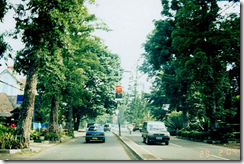 (inset is a photograph of this road in slightly more modern times) and as we proceed down this thoroughfare I guess, correctly, that we are being taken to the headquarters of the Kempei-Tai (Japanese Gestapo). This organisation, which from hearsay and rumour we have already learned to dread, has established itself in the Roman Catholic school of the St Aloysius Brothers.
There is a great activity here. The building is ablaze with lights, cars and motor-lorries are arriving loaded with Europeans, all men, and dashing off as soon as unloaded, presumably to fetch another load.
We are ushered into the entrance hall which seems to be packed with men. I see a number of well known faces among the prospective internees. To right and left along the walls are tables with Japs and natives engaged in what seems to be a preliminary registration or check of the haul. My turn comes and I fill in some form or other which demands only simple particulars of name, nationality, date of birth, etc.
Soldiers with rifles and fixed bayonets bark and grunt at us as we leave the tables and indicate that we are to proceed up the broad stairway which leads from the entrance hall. On arriving at the landing of the first storey my suitcase is searched by a soldier. He apparently finds nothing incriminating but succeeds very well in messing up the contents, so expertly packed by Ena.
Closing my suitcase with difficulty, I and the others in my particular batch, are ordered into a large square room, the floor of which is covered with a sort of thin blanket cloth.
The room is already half filled with men sitting on the floor. The early arrivals are the fortunate ones. They are sitting against the walls and have rest for their backs. No one speaks.
The soldiers shout at us unintelligibly, gesticulating towards our feet.
"Take off your shoes", calls someone softly from the already seated group. We do so and take our places on the floor in the middle of the room. I sit down, leaning on my suitcase and look around me.
I see many friends and acquaintances, both British and Dutch but the majority are unknown to me. Some lean against the walls or sit uncomfortably with closed eyes. Others, like myself, more wakeful, look around and we greet each other with a slight nod or faint smile. We are all feeling a bit dazed, I think.
After a while, I take 'Fate cannot harm me' from my pocket and try to read but I am afraid that nothing registers.
The sentries with rifles and fixed bayonets remain continually in the room, glaring at us balefully through narrowed eyes. These sentries are relieved by others about every 15 minutes, rather ceremoniously. They crash their rifle butts on the floor, bow to each other, utter hoarse shouts, present arms, bark again, crash butts, more bows, and the relief is accomplished. There may be only four different sentries altogether or maybe forty - I don't know. They all look the same to me.
Every ten minutes or so, fresh batches of internees arrive and take their places on the floor. Some, like myself, are fully dressed and carry suitcases. Others have nothing but the clothes they stand in, for the most part an open shirt and shorts.
One man is assisted into the room and is made to sit on a table just inside the door. He has a nasty, jagged wound on his right leg and from which the blood flows freely. I imagine, dramatically, that he has had a jab from a bayonet, but learn, a long time afterwards that his injury has been caused by his falling through a rotten plank on the floor of the truck in which he has been transported. A Jap doctor comes on the scene and renders first aid. The injured man then takes his place on the floor. He is Jack McConnell of the Hong Kong Bank and whom it is in due course to be my privilege to call a friend.
From time to time, a nasty little Jap NCO who is eventually to learn for himself among us the appreciative title of 'Basil the Bastard', checks up on those present by calling out names from lists apparently prepared in the reception hall below.
His weird pronunciation of the British and Dutch names makes it extremely difficult to understand who is referred to. Seeing the difficulty, one helpful member of a newly arrived batch steps to the side of the Jap, looks at the list, and suggest to Basil the B a more understandable pronunciation of the name to which there has been no response.
Basil takes a step backwards, glares at the helpful individual with mad fury in his eyes. Suddenly his hand comes up like a flash. The slap on the face resounds through the room, like a pistol shot.
This first experience of uncalled for and unreasonable Japanese violence, mild though it can be considered perhaps, shocks me to the core and I can't help beginning to feel some apprehension as to the treatment in store for us as internees of Dai Nippon.
The face slapping episode repeats itself a number of times during the long night, sometimes for the same reason as the first when some other helpful individual in a fresh batch makes the fatal mistake of daring to correct Basil's pronunciation, sometimes for other reasons which are clear to nobody but the Japs themselves, and perhaps not even to them.
About 5.00 am a Jap civilian and an officer come in and calls out a list of 30 names. Those called have to line up two deep, with their belongings, at the far end of the room. A few more faces are slapped, and at length the batch is marched out of the room.
This is repeated from time to time and as we hear the sound of motor trucks revving up and driving off outside we gather that we are being moved elsewhere.
In due course, my name is called and I am greatly relieved that I have succeeded in recognising it. I take my place in the row. We are ordered to number off. At the fifth time we do so, the Jap is apparently satisfied. I say apparently expressly because the Japs can't count for nuts!
We go downstairs An open truck has been backed up against the steps of the front entrance. We clamber aboard. We are so jammed that there is no room to turn or to draw a deep breath.
It is still dark. The stars shine above us; cold, beautiful and aloof. A faint paling in the eastern sky indicates that it will soon be dawn. It is chilly.
At an open window to the left of the entrance a Dutch policeman is standing. The Japs are forcing the Dutch police to assist them in the round up. This is Dicky van Ravenswaag Klaassen, an old acquaintance. I wink at him surreptitiously. Dicky, with a perfectly expressionless face, rubs his face meditatively with the widespread first and second finders of this right hand, the 'V' sign.
After some minutes of hoarse shouting and yelling, we drive off. As we turn into the street, I notice two women, Europeans, standing to attention on the pavement surrounded by Jap soldiers. What became of them, I wonder?
We drive east and in a short time, I find myself again in the Houtmanstraat and passing the house where we discharged the 'toekang kebon' (gardener) some 5 hours earlier.
Donald Gow is standing next to me. He says, "They are probably taking us up to Onrust". Onrust is an island off Batavia where the Dutch interned enemy aliens after the invasion of Holland in May, 1940.
I disagree. We are going East, I know, which is the opposite direction to Batavia. My idea is Garoet.
For some reason or other, ever since the possibility of internment has occurred to me, I have always had Garoet in my mind and my imagination has provided me with a picture of myself washing a shirt in a bucket of water in a sort of compound with an open barbed wire fence between me and open country beyond, with the hills in the distance, and behind me a sort of army hut but with vague figures moving in and out. Where this vision springs from, I haven't the slightest idea, but it is definitely not prophetic.
Eventually, we strike the main arterial road, 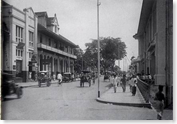 built with the blood and sweat of thousands of natives by Governor Daandels over 120 years ago. We continue east and my belief in Garoet as the ultimate destination is strengthened.
It is rapidly growing lighter and when we have proceeded about 5 kilometres it is full day and the plateau of Bandoeng with its surrounding mountains is revealed in all its early morning beauty. Miles and miles of fresh green rice fields on either side, the nearby hills showing only their tops above the slowly rising early morning mists, in the far distance the mountains, a hazy blue, their lines sharply silhouetted against a clear sky.
We pass through a small village. A few natives on the road gaze wonderingly at the unusual sight of so many 'tuans' (white gentlemen) travelling in such unorthodox and undignified fashion.
We breast the hill this side of Soekmaniskin. Soekmaniskin! Surely not! The prison comes into sight and my sinking heart drops with a thud into my boots as the truck slackens speed just before the road which strikes off to the left, leading to the main gate.
Yes, there is no doubt about it now. Soekamiskin Penitentiary is our destination. We leave the main road and drive down the slight incline to the grim and forbidding looking building. The truck backs up against the massive doors of the main, the only, entrance.
A small observation window set in one of the doors opens and a confabulation takes place between those inside and our escort of Japs and policemen. The window closes and we stand in the truck waiting, a long time, some 15 minutes.
The doors swing open inwards and we clamber off the truck and pass within. We find ourselves in a sort of hallway about 30 feet long by perhaps 15 wide. At the far end the heavy doors now between us and the outside world are duplicated. To the left, a number of doors leading presumably to offices; to the right more doors and a stone staircase leading upwards to regions unknown.
After a lot of shouting and misunderstanding due to misinterpretation presumably of the Japanese orders, transmitted to us through the native police, we are lined up on each side of the hall with our belongings opened up for inspection on the floor before us.
We are ordered to put all sharp objects, such as razors, scissors, nail files and the like into big envelopes which are handed to us. All luggage is at the same time submitted to close search by the soldiers. As is to be expected by this time, a few faces are slapped.
Then money is to be handed over. For this operation we are taken upstairs into a small room where we sit on benches in a group. At a table just behind the door, the European governor of the prison is sitting on his chair with one leg drawn up under him, like a Budha. I understand this peculiar attitude some 3 years later when, to my great satisfaction, I see the same man sitting on a stool with both legs in the same position in the internment camp at Baros and am told that he is indeed a Bhuddist.
This man is Baudisch, an Austrian, I believe, and who, I am given to understand, had prior to Holland's entry into the war displayed Nazi tendencies. For reasons best known to the Dutch authorities themselves he has been retained in Government service as prison governor. His attitude now and later makes it clear that , in his opinion, his day has come.
Our names are called in turn and we step forward to the table and hand over the money we have on us. The amounts are noted in a book and the money placed in envelopes. I find that I have with me thirty guilders and nineteen cents.
The operation completed, we go downstairs again. We pick up our luggage, that is to say, those of us who are fortunate enough to have any, the heavy doors leading to the interior of the prison swing open. Two by two, like the animals going into the Ark, we pass through, cross an open space and enter then the main building of the prison.
We find ourselves in a long, echoing, stone paved corridor about 20 feet wide. A narrow gallery runs along each side. On right and left nothing but doors, both with the upper storey and on the level. Some of these doors stand open. I am not very bright this morning. As we march along , I think "What a lot of of lavatories."
Bang! Bang from ahead of me. I can't see what is going on exactly. We are being escorted by Jap soldiers and European individuals clad in a sort of blue uniform. One yells instructions in German. I think, "Michty me, they have handed us over to the Nazis."
Bang! The man ahead of me disappears.
Bang! I find myself in one of the 'lavatories'
This is to be my abode for 22 months.
******* to be continued


 Posts
Posts


