Showing posts with label java. Show all posts

Tuesday, 29 December 2009

…. 5 September 1942

A day of days!  This morning out from 10 to 11 am.  We were officially informed that the Nips have departed for good and that we shall henceforth be the responsibility of the Director and ordinary prison staff.  It is too difficult to realise yet fully what this means, the tremendous relief from the strain under which we have lived for the past 5 months almost, to appreciate the fact that we can now live more or less normally and subject only to well defined restrictions.  I have gone down on my knees today.  Exchanged ‘The Alain Family’ yesterday for ‘Van Java’s Wegen’ by J E Jasper and that today for ‘Pension Vink’ by F de Sinclair.  Mingail’s baby is 2 years old today.  His own birthday was on 25 August and his wife’s on 27 July.

____________________

One of the first things I did when I was once settled in my bungalow was to purchase some hens.  Being town bred this acquisition had great attraction for me and I was so impatient to see chickens hatching out that a few times a day I would left up the brooding hens from their nests to see if there was anything doing under them.  After a few days of such inspection I became aware of an uncomfortable crawling sort of itch all over my body and by dint of careful scrutiny of my anatomy discovered that I was simply crawling with minute vermin known as hen lice.  I do not know if fowls at home are subject to this particular pest but I can answer with conviction for those of Java.  Needless to say, after this experience I was content to let nature take her course without further interference on my part and in due course had as many chickens as I could wish for, to my great pleasure and satisfaction.  I have heard it said that a hen can be mesmerized by having its head inclined to a chalk line on the ground but have never tried this or seen it done.  I can however vouch for the fact that if you take a chicken in your hands and turn it over quickly so that it lies on its back on the palm of one hand it will nine times out of ten stay in that position until you choose to put it on its feet again.  Later on I increased my fowl possession by the addition of some ‘entoks’ which, I believe, are a cross between ducks and geese.  They are good eating.  Their eggs, also good, are, however, sterile.  Entoks I should think, are the mules of the poultry world.  I man mention that within less then a year my entire poultry yard was wiped out in the course of a few days by an epidemic of chicken cholera which swept with the rapidity of a forest fire through the district.  I do not know sufficient about poultry at home to be able to tell whether or not such a disease is there prevalent, but in Java at any rate it is so common as to render any attempt at chicken farming a rather precarious undertaking.  The course of the disease is rapid with about 24 hours only between infection and death.  In my own stock, between 30 t0 40 hens died in a single night.  The cholera strikes suddenly, the symptoms being inability to swallow and standing hunched up with the eyes partly or even completely closed.  I have known a hen remain in the condition for days and die eventually of sheer starvation but this is not common.  As I have said, death usually supervenes within 24 hours.

_______________________

An issue of 3 packets of the ‘A’ cigarettes this afternoon.  The ‘A’ which had evidently been pasted on to the packet, on being removed reveals a ‘V’.  The cigs appear to be of Chinese manufacture and cost 6 cents per packet – Virginia and quite good.

Friday, 9 October 2009

25 August 1942

The Tjitandu was a troublesome river during the rainy season, often causing serious floods in its lower reaches, where Langen was situated.  As protection for Langen and other neighbouring low lying Estates an earthen dyke had been thrown up along the south bank for a distance of 9 kilometers but even this precaution was on occasion not proof against the forces of the water and a break in the dyke would result, with serious consequences not only to the gardens  but imagealso to native kampongs and to the railway.   I had only been a week or so on Langen when such a break occurred but fortunately this took place near the east boundary and actual damage to garden was slight.  Much more serious was that in, I believe, the beginning of 1931 when the dyke gave way about the middle of our river boundary.  I was garden assistant on Straits of Java Division at that time and my young garden in the south east corner of the Estate was flooded to a depth of 4 feet of muddy water.  I had to go out with the gang of native labourers to secure the wooden bridges which spanned the big drains crossing the roads at intervals and I floundered up to my arm pits in water from 7 am till noon with snakes of all kinds, which had been driven out of the undergrowth by the encroaching water, swimming literally in dozens past my nose, sometimes uncomfortably close to that organ.  The instinct of self preservation was however too strong upon  them and they were not interested just in a mere man.  Later on, when I walked, or rather swam, along the southern boundary, which was marked off by a high hedge of lamtoro trees, these trees were simply festooned with snakes which had at last found something to hang on to.  On that memorable occasion my favourite dog, Lockie, a dachshund of somewhat doubtful parentage, accompanied me the whole time, swimming like the other which is the natural prey of his breed, with, an occasional helping hand under his chest from myself.  And as luck would have it, on that day he actually found an otter in one of the major drains and a terrible fight ensued in which poor Lockie was more under water than above it.  The other won, that is to say in as much as Lockie eventually decided that on this occasion discretion was the better part of valour and retired from the fight.  The houses on Langen were, for the most part, well and solidly built, high in the roof and with thick brick walls, a construction which ensured their being as cool as was possible under the circumstances.  The heat and humidity were indescribable and I do not exaggerate when I state that for 5 years my body was never dry.  The atmosphere lay on one like a heavy, damp, woolen blanket and it was very seldom, hemmed in as we were by high rubber trees, that we experienced the relief of a breeze.  My first house consisted of four apartments, dining room, sitting room, bedroom and a verandah open on two sides, except for a low balustrade, kitchen, store room, bathroom etc were outbuildings built in a  row and connected with the house itself by means of a roofed over passage which ran from the rear door of the dining room.  it was in this house that a thing, for which I have never been able to offer any natural explanation, occurred.  The servants leaving every evening after dinner, I was always alone in the house from about 8 pm till 5.30 next morning when  my ‘boy’ roused me by knocking on the window of the bedroom.  Last thing at night before going to bed I used to check up on all doors and window fastenings.  One morning, on emerging from the bedroom into the dining room to open the rear door for my ‘boy’, I was amazed to find one of the four chairs placed round the dining table lying flat on its back on the floor, just as if it had been placed carefully in that position.  I well swear that the chair was in normal upright position when I went to bed the night before and that nobody could have entered the house during the night.  Also, I had not been disturbed by any noise.  I should add that the chair as quite intact when examined.  So, what is the explanation?  I was puzzled then and still am.  Servants were soon engaged for me, a house boy, a cook and a garden boy.  My boy was an elderly Javanese named Resodikromo, or Reso for short, and he served me faithfully for my 5 years on Langen.  Cooks and garden boys were more like a procession during that period.  Some cooks were bad, others not so bad, sometimes Soendanese, sometimes Javanese.  How they ever managed to turn out anything eatable at all from the very primitive kitchen and appurtenances thereof is a mystery.  Along half of one wall of the kitchen ran a sort of tunnel of brickwork about 10 inches square, open at one end communicating with a chimney at the other, and with three or four circular openings in the roof of the tunnel on which pots and pans could be set.  Billets of wood were inserted at the open end and, when set alight, the flame was drawn by the draft along the tunnel. The circular hole nearest the the mouth gave, of course, the greatest heat and each successive hole a lesser degree so that cooking in all its stages could be dealt with.  Primitive indeed but immensely practical.  Holes not in use at any time were simply covered with a piece of tin cut to fit the apertures.  There was of course no lack of firewood as diseased trees in the gardens were being continually uprooted and firewood, in the terms of my contract, was free, like the house and garden boy for whose wages an allowance of 12 guilders per month was granted.  We usually paid 8 guilders and so were 4 guilders to the good in that respect.

_________________________

Out today from 2.40 to 4.30 pm. Run round, ball game and jerks.  This morning got 2 Davros cigarettes from a jay sentry.  Gave one to Mingail, my neighbour, whose birthday it is today, his 33 rd.  The Director personally brought to him a photo of his baby girl, aged 2, but apparently nothing else was, allowed in.  In connection with the cigarettes I got this morning, my neighbours ascribe this to my usual luck.  I protest that it is not so much luck as merely adhering to the maxim that if you don’t ask for a thing it is practically 100% certain that you will get nothing, whereas if you do ask, there is a fifty fifty chance of your getting something, even though it may by only a kick in the pants.

Thursday, 1 October 2009

24 August 1942

However, with what was left, it was possible to purchase such necessaries as a dining table and chairs, sideboard, wash stand etc all second hand  of course.   I also bought half a set of the cheapest plain white crockery.  Fenton then brought ne to one of the hospitals, as I have omitted to mention Graham’s also doing in Batavia, to satisfy the authorities, that I betrayed no symptoms of cholera.  In accordance with regulations and because, I believe, an outbreak had occurred in Singapore while I was there, this examination had to take place on three successive days.  Between Bandung and Langen we had to break our journey the following day at a place called Tasikmalajaimage for the same purpose.  While awaiting the train in Tasikmalaja, we sat in the Club there which was quite deserted except for ourselves and an elderly fat Dutch planter, manager of an estate in the vicinity, who offered us drinks and was scornfully amused at the idea of a Scotsman preferring a sweet soft drink to his native whisky.  We reached Langen Estate in the early afternoon and repaired to Fenton’s house, where, according to custom, I would stay a month in order to become accustomed somewhat to things in general before being left to paddle my own canoe.  As a matter of fact, it was Fenton who left at the end of the month, I remaining in the house, he having been transferred to another part of the Estate.  After lunch, we went to the Estate office where I met Mr Fitz Verploegh, the manager, who after greeting me said, indicating the office, ‘Well, this is your place for the next 5 years.’  The prospect at first sight did not seem encouraging.  The office was a bare looking room about 20 feet square with whitewashed walls, with a battered looking desk in the centre with an equally decrepit chair behind it and one or two tables and chairs against the walls.  In the corner opposite the doorway was a small safe set in a projecting mass of concrete.  This safe, I learned later, had formerly stood against the wall on a strong wooden rest, but one day, the then bookkeeper had closed the door of the safe, which locked automatically, leaving the only key inside.  The only way to right matters was to burn a hole in the back of the safe with an oxyacetylene blow lamp and subsequently the only way to preserve the safe’s usefulness was to embed it in concrete.  It was a brilliant solution because in its present state it afforded a hundred times better security than it had done as a loose steel box.  To give a general idea of Langen Estate I would explain that practically the whole area was reclaimed marshland and as flat as a billiard table.  Drainage of ground water was the major problem and an elaborate system of drains and pumping installations was the result.  The Estate was divided into so called Divisions; an employee residing on and being responsible for each Division.  These Divisions were subdivided into Gardens marked out in square areas.  The rubber trees were planted in straight rows and equally distant from each other. image Between each third row of trees, in both directions, were ditches for leading off water.  These ditches communicated, by way of deeper ditches crossing the garden at intervals, with drains about 6 to 8 feet deep running round the borders.  These again were linked up to so called main drains, which were really miniature canals, and which flowed, albeit sluggishly, into the marshes to the south.  The oldest trees on Langen had been planted in 1905.  A rubber tree comes to maturity and can be safely tapped at 6 years old as a general rule.  There was no road on to or off the Estate as far as the outside world was concerned.  The only communication was by the railway which cut the plantation in two from East to West.  Langen had a miniature station, known as a Halte, at which only the local train stopped, and from the main line a siding ran to the Factory godown (warehouse), where the cases of rubber were stored against despatch.  Java is divided roughly into three parts, known as West Java, Middle Java and East Java.  There is a strong similarity in population to our own country, in that Java harbours two distinct races, the Javanese to the East and the Sudanese to the West.  These two people are as distinct in race on the Scot and the English, but even more so in language, dress and custom.  Roughly speaking, the Sudanese inhabit the West Java and the Javanese Middle and East Java.  Langen was situated where West merges into Middle Java with the result that the labour was a mixture of Sudanese and Javanese, thus occasioning a knowledge of both languages in addition, as was my case, to Dutch and colloquial Malay.  In due course, I spoke six languages every day.  English to the manager because he preferred to speak that language, Dutch to the other assistants, Sudanese to my native overseer, Javenese to the coolies, Malay to the office clerks and Scots to my dogs!  The Halte was situated about the centre of the Estate, the manager’s house and two assistants’ houses forming a triangle with the Big House at the apex, about two hundred yards to the East of the Halte on the North side of the railway and roughly a hundred yards from the track, and the Factory buildings immediately opposite on the other side of, and about 50 yards from the railway, my house was situated at the base of the triangle nearest the Halte.  When I arrived the staff consisted of the manager, Fitz Verploegh whop was Dutch; Fenton of Scottish parentage but brought up in England; Van Der Meulen (from whom my bed was purchased) a Dutchman; Drost, idem; Vacquier, Eurasian; Sator de Rotas (engineer) idem; and Raden Kusumbrata, Soendanese.  Fenton, whose place I was taking as book keeper, was now going on full time garden work with his own division.  Van Der Meulen, Drost, Vacquier and Kusumbrata were all divisional garden assistants.  The divisions were, from east to west, Langkap Lantjar (Drost); Hevea (idem); and Straits of Java (Fenton) south of the railway, and ‘A’ Block (Vacquier); Langen (v/d Meulen) and Tjigaron (Kusumabrata) north of the line.  Langen Estate, as it now is, was really an amalgamation of several small estates in previous years and which had bequeathed their names to the divisions which they had now become.  Seem on a chart, Langen Estate was an irregular rectangle about 5 miles long by 3 broad situated, in its length, between two natural boundaries the Rawah Lahbok marshes to the south and the River Tjitandoei to the north.

_______________

Out from 2 to 3 pm only this afternoon.  Library books collected this morning.  New issue this afternoon.  Got ‘Woodstock’ by Sir Walter Scott.  Run round, jerks and only one ball game for veterans today.

Tuesday, 4 August 2009

21 August 1942

Mr Templeton assisted me in buying a cheap suitcase and a solar topi in Penang.  The suitcase was necessary because my mother had packed my trunk and leather suitcase so well that after having removed various articles in the course of the voyage, I could not with all my ingenuity get everything back in again.  In fact it was even a tough struggle with an extra bag.  My friend strongly advised me to buy a good topi while I was at it and recommended an Ellwood which, he assured me, would last me for years.  He was quite right, I have that topi yet.  But all the same such a topi had its disadvantages.  In the first place it was far too heavy and secondly the shape was not fashionable in Java.  A cheap, light, pith topi which can be purchased for a few guilders is much more comfortable and serviceable in addition to being of a shape which gives very good protection for the back of the neck.  When it begins to get shabby it can be passed to your ‘boy’ as a very acceptable present and a new one purchased and it will be many years before the expense of a succession of such topis equals the cost of an Ellwood.  I paid $30 for mine.  In spite of the above stated disadvantages, however, true to type, I wore the Ellwood for the 5 years of my planting career and, just because it cost so much have not yet been able to bring myself to parting with it.  In the afternoon we ascended by funicular railway to a tea house set on a hill and from which a marvellous view of Penang and lesser island around about could be obtained.  When we arrived in Singapore a day or two later I looked out anxiously for the representative of Harrison’s and Crosfield who was to look after me.  To my dismay nobody appeared.  I was at my wits’ end, for remember I was for the first time in my life absolutely alone and with only myself to depend upon and I had so far no experience of standing on my own feet.  Furthermore, I was in this condition in a very, very strange land, thousands of miles from home.  Ultimately, a fellow passenger and brother Scot named Barker, who was transshipping at Singapore on his way to the oil fields in Miri, British Borneo, suggested I should go with him to the town and find the office of the firm.  We stepped into a taxi which soon brought us to the building.  There we found everything closed and learned that that day was a public holiday in Singapre and all offices closed.  Going into a post office along the street to buy some stamps, I noticed that the door of the bank just opposite was open, so leaving Barker for the moment in the post office I crossed the street and entered the building in the hope of finding someone who could put me in touch with the powers to be of H & C.  There was only one man, a European, seated at a desk in the large office and to him, apologising for disturbing him, I explained my difficulty.  He was very sympathetic and informed me that I would have very little chance of finding anybody that day and advised me to put up at an hotel and call H & C’s office next day.  He asked me where I came from and when I told him Aberdeen, it was strange to hear him remark, ‘Is that so?  I was up at Aboyne just the other day.’  He had apparently just returned from leave shortly before.  In the course of our conversation he learned of my destination and conditions of employment.  When I mentioned that the commencing salary was 250 Guilders a month he exclaimed, ‘What a damned shame.  How can they expect anybody to live on that?’  Needless to say, this did not help the least little bit to raise my already fairly low spirits.  Happily, however, as it proved, he couldn’t have known what he was talking about.  The salary was ample, but he was probably applying Malaya standards to the sum stated.  On rejoining Barker, who had also not yet removed his luggage from the ship, we returned to the ‘Khiva’.  As I was somewhat apprehensive of putting  up at a hotel, being not too flush with money and also not very certain if such a course would have the approval of H & C, and knowing that the ‘Khiva’ was to lie two days in Singapore, I made bold to ask the purser if I could stay the night on board, explaining the circumstances.  He just looked down his nose at me and replied, ‘The PO Company undertook to bring you to Singapore.  You are here, and we have no further concern with you.’   Since then I have felt that if there should be no other ship available but a P&O liner, I would rather swim than let that company have a penny of my money.  However, Barker and I got our luggage together and having passed the Customs without difficulty we repaired to the Adelphi Hotel where we each took a room.  The next morning early I was at H & C’s office.  Empty apologies, of course, for the blunder and all that and just send the hotel bill to them.  I found I had to stay five days in Singapore before I could get a boat to Java and during that time Barker and I wandered about Singapore although I cannot recall very much of what we saw or did.  Only two things are vivid in my memory.  One occurred the first night I was in the Adelphi.  My room, whcih was on the second floor, overlooked a narrow busy street and just after darkness had fallen I was startled by a hellish commotion of shrieks, yells, shouts and shooting from the street below.  Quite convinced that I had landed in Singapore to see the beginning of a revolution, I dashed to the balcony rail and peered cautiously down.  I then discovered that the noise was caused my some kind of procession, which was preceded by several persons letting off squibs and firecrackers to a running accompaniment of weird yells.  I learned later that it was only a Chinese funeral and that all the noise is indulged in with a view of scaring away any which may have evil designs on the soul of the departed.  I may state here that my idea of a revolution was not so far fetched because at that very time a fairly serious revolution was taking place in West Java and of which we had had daily wireless bulletins on the ‘Khiva’ and reports in the Singapore newspapers.  Fortunately, however, by the time I reached Batavia, where many serious incidents had occurred, the rising had stopped and the authorities had the situation well in hand.  It is interesting to note that in the book ‘Out of the Night’ by Jan Valtin, the writer claims that it was he, as a Bolshevik emissary, who conveyed the instructions and plans for the 1926 Java riots to a Chinese woman in Singapore.

____________________

Out from 2 to 3.30 pm.  Two ball games, first for veterans.  Second game broken off during the first half by order to return to cells.  Issue of one packet of 20 ‘Mascot’ cigarettes.  These issues are, of course, debited to us and paid for from the money we brought in with us.  No money, no cigs.  I had about 30 guilders and have since had transferred to may account of 50 guilders and later 25 by my partner, Sparkes, who brought 600 with him.  My balance at the moment in the region of 40.  The rest has gone on so called medical supplies for which we have had to pay outrageous prices.  Exchanged ‘Uncle Tom’s Cabin’ for ‘William Pitt’, a biography by Macevlay.  Also reading a crime Penguin, ‘The White Cockatoo’ by M G Eberhard which Benson lent me yesterday.

Tuesday, 21 July 2009

20 August 1942

Out yesterday only one hour, 3 to 4 pm.  One ball game for veterans over 45.  New Officer.  Light dim all last night. No alarm.

_______________________________________

Talking with my neighbour No.315 Mr Mingail, about the Port Said nuisance, he told me an amusing story of the experience of a friend of his in that sink of iniquity.  One form of nuisance which I have omitted to mention is to be found in the conjurors and sleight of hand merchants who seem to be the first on board when a ship docks.  This specialty seems to be the producing and causing to vanish of day old chicks but the programme is varied by sleight of hand with coins etc.  On this occasion the conjuror had as usual succeeded in collection a small crowd of passengers around him by various feats of his art when he suddenly said, ‘Will one gentleman give me a £1?’  A spectator handed over a £1 note (the sap) and the conjuror then said to him, ‘Now, gentleman, must say what I say – quick!’  After repeating ‘Go'!’, ‘Come back’, etc while the £1 note, in the hands of the conjuror disappeared and reappeared accordingly, the rascal said, ‘Now gentleman say quick, ‘Run like the devil.’  The gentleman did and the conjuror did, to the great amusement of the other spectators and to the great discomfort of the gentleman concerned, leaving him a poorer, sadder and, let us hope, a wiser man.

I made the acquaintance of some nice people on board, particularly a Mr & Mrs Templeton and a Miss Lund.  The Templetons were a Scotch couple.  Templeton himself being a mining engineer employed at the mines in Ipoh, FMS (Federated Malay States), returning to duty after furlough.  Miss Lund was a middle aged little woman who was going to an estate in Java as governess to the manager’s little daughter.  Mrs Templeton undertook to assist me with Malay and, thanks to her helpful hints, when I arrived in Singapore I was fairly capable of making my wants known in that language.  Unfortunately, however, these studies did not help me, when I reached Java, where Malay differs greatly from that spoken in the British settlements.  The Malay language of Java and other parts of the Dutch East Indies is very much influenced by Dutch and even remnants of Portuguese.  I refer, of course, to the colloquial form.  Books and newspapers are printed in pure Malay and can be read anywhere by those who understand the pure tongue.  Miss Lund, who had held a position in Java before and although she could not speak Dutch, was able to help me considerably with that language by her knowledge of it otherwise.  It is quite common to find British people, but especially the English, in Java, who understand Dutch but who do not speak it, either because they dare not, or, as I personally am inclined to believe, because they will not on lamentable conservative principle.  We arrived eventually at Colombo where (all I can recall on that occasion) a party of us visited Mount Lavinia Hotel, picturesquely situated on the sea shore.  I can also remember how interested I was in the carved, so called ebony, elephants which were being offered for sale along the approach to the hotel.  The next port of call was Penang where my friends the Templetons disembarked.  They spent the day in Penang, however, and we had a pleasant lunch together in one of the hotels there where I was introduced to the repast known as ‘rice table’, or rijst tafel is it is called in the Indies, where, I understand, it originated. No guide book of the Dutch East Indies or book of memoirs describing a visit to these delectable isles, would be complete without a chapter devoted to the description and the delights of rijstaffel.  Although these rambling jottings are neither the one nor the other I shall, however, endeavour to describe rijstaffel procedure.  The dish varies greatly in scope and variety but to give an idea of rijstaffel in its most comprehensive and expansive state I cannot do better than take as an example the serving of it as extended at a first class hotel in Java, imagesuch as, for instance, Hotel des Indes in Batavia.image 


Imagine yourself sitting in the large dining room there, preferably under one of the many ceiling fans and that you have decided to indulge in rijstaffel.  Having given your order to the ‘boy’ who waits on your table, the decks, so to speak, are first of all cleared for action by the removal of such appurtenance before you as pertain to the eating of European food and the setting before you of a deep soup plate (in some hotels almost twice normal size) a smaller flat plate on the left, and a knife, fork and spoon.  The fork and spoon are the actual weapons with which the dish is attacked, the knife only being brought into action occasionally in cutting a piece of meat etc.  In due course, a ‘boy’ appears at your elbow offering white boiled rice in a large bowl.  Turning to help yourself to rice you will notice a second ‘boy’ behind the first, a third behind the second and so on apparently ad infinitum.  If this is your first experience of rijstaffel you may be pardoned if your first inclination is to bolt from the literal chain of events which your simple order has put into operation.  From your table, winding like a snake among the other tables in the dining room, right to the entrance to the kitchen, in a procession of dusky, white clad waiters, each bearing a dish in each hand.  And as each submits his particular offering and moves on, it seems that another adds himself to the chain emerging from the kitchen until you feel that you are doomed for the rest of your life to being served only and that the time will never come when you will be allowed to start eating.  The second ‘boy’ presents a greenish liquid which is a sort of soup of green vegetables and which serves more or less to dampen the rice already heaped on your plate.  Thereafter in succession you are offered a truly bewildering variety of dishes representing fish, meat, poultry, vegetables etc in a myriad disguises, practically all flavoured and spices with strange and assorted sauces.  Meat appears, in addition to plain sliced roast, shredded and fried mixed with grated coconut for mixture, chicken livers and kidneys diced floating in a brown sauce, fish friend or salted, eggs smothered in curry sauce or other condiment, cucumber garnished with Spanish pepper, chicken roast or curried, oysters and shrimps boiled or fried with various sauces and a countless assortment of concoctions in which fried bananas, tomatoes, peanuts, grated coconut are mixed, each having its distinctive flavour depending on the mixture and spices and sauces employed.  Without foreknowledge or more or less expert advice in choosing these dishes, you will probably feel that the top of your head has blown off as the result of your having unwittingly put into your mouth a spoonful of skillfully camouflaged chili peppers.  For real, rip snorting dynamite, I commend you to the chili peppers (tjabe) of Java.  You are, of course, perfectly free in your choice and selection of the dishes offered you but there is a real art in knowing what to accept or refuse and also how much, or rather how little, of each dish.  if you are tempted to take large portions from, say, the offerings of the first 10 boys you will be sorely put to it to find room on your plate and side plate for the very appetising looking dishes which ‘boy’ number 26 or 27 presents to you.  Generally speaking, the side plate is used for pieces of meat, game, fish etc, the cutting up of which would be impracticable on the deep plate which is heaped with rice and the other 57 varieties.  In the actual eating of rijstaffel you may mix the whole up together, thus combining all taste and flavours, or you may flit from meat to fish, fish to chicken etc achieving a different effect on the palate which each accompanying spoonful of rice.  By the time you are finished eating, you will feel that you will not require another bite of food for another week at least and your immediate desire will be to retire to your bedchamber and to spend the next 3 hours in profound meditation.

____________________

Out from 3 to 4.15 pm.  One ball game.  A chap named McLaren in the East Wing got a nasty smack on the nose playing ball last week and was afraid it might be broken.  He went on sick report and the doc without even examining or feeling his nose prescribed him some aspirin powders.  My neighbour, Mingail, who has a sprained ankle goes to the doctor tomorrow and we are expecting that the treatment in his case will be a dose of castor oil

Friday, 26 June 2009

17 August 1942

Out yesterday 3 to 5.15 pm/  Three ball games.  Supper very late – 7 pm instead of 5 pm but worth waiting for.  A change form the Ketan Hitam this morning.  Rib improving but still painful.  In spite of doctor’s instructions that the part should be painted with iodine every day, this has not been done.  As the medical service is here, it would be very surprising indeed it it had been.  I shall just have to practice Christian Science.  Two alarms already this morning but quite evidently only practice.

____________________________________

I returned to Braemar the same day and finished my holiday there.  A letter from Harrisons and Crosfield awaited me at home, with the request to be at their office in London on the following Tuesday for interview.  It was asking rather much to require leave of absence the very day after I had resumed duty but I was granted one day which was quite enough for my purpose.  I accordingly left Aberdeen at 7 pm of Monday evening, arriving in London at 7 o’clock next morning, returning by a train leaving London at 7 pm Tuesday which got me to Aberdeen by 7 am Wednesday morning, in good time for work. image Arrived at King’s Cross Station, I had a wash and shave in the toilet rooms there and then breakfasted in the Station restaurant.  My interview was for 10 o’clock but I was already in the vicinity of Great Tower Street by 9 am and sat on a bench on Tower Hill overlooking the Tower of London until the appointed hour.

I was interviewed by Mr Mitchell and Mr Thom who himself was a native of Dyce and the ordeal passed pleasantly.  At one point during his questioning he said to me, ‘You are not thinking of getting married, are you,’ to which I replied trustfully and rather bashfully, ‘No, not yet – but I have a girl.’  This simple question and reply were to have momentous consequences later.  However, after an interview of about half an hour, Mr Thom expressed himself satisfied and intimated to me that the appointment was mine.  The contract would be made up and I must return at 3 pm to append my signature and receive my copy of the document, together with sailing instructions etc.  Greatly elated at my good fortune, my first action on leaving the building was to send off a telegram to my parents which contained only two words ‘Got it’.  Thereafter, feeling in fine fettle I set out to see as much of London as my limited time would allow of.  Somehow or other, I found my way to the Monument which I climbed. image  It was a beautiful sunny day and the panorama of the great city spread out below me amply compensated for my breathlessness. imageI forget exactly how many steps there are in the Monument but more than enough is a fairly accurate estimate.  


From there I found the direction of St Paul’s Cathedralimage which I reached in due course and where I ascended to the Whispering Gallery,  in which the guide demonstrated the famous acoustic properties, and then to the top of the immense dome itself from which another magnificent view compensated me for my weary legs.image

I must have lunched somewhere but have no recollection of the proceeding and at 3 pm duly presented myself again at the office in Great Tower Street.  The contract awaited me, an imposing looking document of 8 foolscap pages simply bristling with seals and flourishing signatures.  As our American cousins would put it, it sure looked a million dollars but it proved itself latterly to be as valuable as the illuminated share certificate of a phoney gold mine. image Mr Thom informed me that I would sail on 16 October from London by SS Khiva of the P & O line,  transshipping for Java at Singapore, where I could apply to their office there for the necessary assistance and that the boat would be met by a representative who would arrange accommodation etc in Singapore for me.  On arrival at Batavia, Java, I should also be  met and taken under the wing of a member of the office staff there who would see to it that I reached Langen Estate safely and in one piece.  I was also advised to buy Hossfeld’s Dutch Grammar and Hugo’s Dutch Simplified.  This I duly did and to this day have never got beyond the first page of Hossfield.  But I must confess that Hugo’s book was very helpful indeed.  I spent my few remaining hours in London on the open top decks of buses, enjoying myself immensely in the contemplation of the most fascinating sight London can offer – the traffic.  A few days after my return to Aberdeen, I received my passage ticket and luggage labels and a cheque for £10 travelling expenses.  I was however very short of money for the purchase of the necessary outfit and consequently rather worried on that account.  I was at Northern Branch at the time and I confided my difficulty to Mr Grainger who very kindly approached a friend of his, a depositor at Northern, on the matter.  This was Mr William Riddoch, an elderly cattle dealer, with whom I myself was only slightly acquainted, but whom I learned to regard as a true friend and to respect as  a Christian gentleman of the finest type.  William Riddoch was a bachelor and a plain honest living and God fearing man whose guide in all his dealing with his fellowmen was the Good Book.  I learned later that I was by no means the first, and I am sure not the last, young man whom he assisted in a practical manner towards the goal of his ambitions.  In fact, it was rather a hobby of his to do good in this way.  Briefly, he advance me the sum of £60 which I undertook to repay as soon as I could.  I am glad to say that I did so within the year, thus discharging the financial obligation.  His kindness can never be repaid.  He himself considered that he was amply repaid if his protégés made good and was always ready to adopt one, even although in some cases he had been bitterly disappointed in his trust and his kindness shamefully abused.  When I expressed my gratitude to him, he replied, ‘ That’s alright laddie.  But just remember later when you have the means and opportunity to help some young lad as I am helping you now.  That’s all I want.’  Could there be a better rule for living than that?  William Riddoch was a simple man with I imagine, little education, but with more men of his stamp and less so called education, this world would be an infinitely better place.  He as passed on now but to me his memory will every be green and I shall not fail him in his precept.

_________________________

Out from 3.10 to 4.30 pm.  Ball games.  Bill Leslie got a parcel in yesterday from Lydia.  He gave me 2 biscuits, double ones with icing in between and 3 candy balls.  All finished.  I have still got 2 squares of Swiss milk toffee and 5 Capstans.

_________________________

My outfit was soon purchased and packed in a steel trunk which I bought from Shirras Long and a suitcase which was a parting gift from the Grosvenor Choir.  I had quite forgotten about my Choir until mention of the suitcase reminded me of my career as a choir conductor.   It is difficult to recall how it came about exactly but I suppose I was asked to form the choir which was composed of members of the ILP (the Independent Labour Party) of which my mother, having inherited her father’s interest in matters political, was an active supporter.  Politics have never interested me but if I have had my leaning in that direction at all, it has been towards the Socialist movement on account of its practical policy of endeavouring to secure better conditions for the masses.  I spent many pleasant evenings in the Grosvenor Rooms in Bridge Street where the ILP members foregathered and where, after the Grosvenor Choir was formed, rehearsals were held.  The choir was a mixed one of about 45 members, some staff readers but the majority sol fa and it was due much more, I am sure, to the unbounded enthusiasm of the choir as a while than to my capabilities as a conductor that the enterprise was so successful.  Without boasting, I think I can claim that the Grosvenor Choir was as good an amateur ensemble as could have been found in Aberdeen at that time.  It was, I believe, in 1924 that the choir was formed and I remember very well our first performance which took place one Sunday evening in the Picturedrome in Rosemount Viaduct.  In addition to the many part songs, about 12 in number, there were solos and quartettes and instrumental items as well as a few humorous Scotch recitations and our debut was an unqualified success.  From the ranks I had been singularly fortunate in forming a mixed quartette whcih , for the perfect blending of four voices, I have never heard equalled.  None of the voices was a powerful one and no ne voice at any time predominated so that singing in harmony was well nigh perfect, and especially in such a part song as Sweet and Low.  My sister Marjory was the soprano, Edith duff (?) the alto, Frank Pirie, tenor and Alex Catto (latter Councilor) bass.  Frank Pirie possessed one of the sweetest natural tenor voices I have ever heard.  He was very thin and consumptive looking and solo singing was apt to distress him somewhat.  Hardly to be wondered at considering that the poor chap was under nourished and had been out of work for about 2 years already at that time.  He was one of the finest men I have met and it is a privilege to have known him.  Poor frank was one of the victims of the first bombing attacks on Aberdeen in September 1940.  When I resigned from the conductorship on  leaving for Java, my uncle Peter took over the choir but some six months later, I believe, it was disbanded.  However, as I have already stated, the Choir presented me with a splendid leather suitcase which I used still and which forms a link with a very happy period of my life.

***********

Note from Pat O’Neill

Last year my daughter was taken to the Whispering Gallery where her future husband proposed, little realising that her grandfather had been there all those years ago!

Wednesday, 24 June 2009

16 August 1942

Last night lights dim till 9 pm then complete black out till 11 pm after which lights dim for the rest of night.  Rib still painful, pain now localised under right breast.  Twenty odd new people including 2 women, have arrived and are in the West wing.  Too far to see who or what they are.

___________________________

Mention of John Wilkinson reminds me of a serious illness I had, in, I believe, 1932, of which John was the indirect cause but not in the least responsible.  He was a very fine swimmer and one Saturday afternoon while we were together in the Bathing Station of the Beach, I persuaded him to teach me to dive from the springboard.  I got the knack of it in due course and was so enthusiastic that I kept on diving long after John had left the bathing station.l  The same evening I had a bad headache with a dull throbbing in the ears and by the next morning I was in agony with earache and running a high fever.  The doctor was called, diagnosed abscesses in both ears and prescribed treatment.  For days I lay practically unconscious with the intense pain.  In due course, thanks to my mother’s careful nursing, the pain subsided, but leaving me as weak as a kitten – and stone deaf!  The doctor told my mother that there was nothing more to be done as both eardrums were perforated and that I would never recover my hearing.  Fortunately, I was not aware of the verdict, whcih was probably just as well and my mother refused to accept it.  on her own responsibility she intensified the treatment, washing out and dressing my ears every hour, day and night, and achieved a miracle.  My hearing gradually came back until eventually it was as good as formerly, probably better on account of the drastic clearing my ears had undergone during the treatment.  I owe the recovery of my sense of hearing to my mother alone, God bless her.  It was during those  years, too, when I took enthusiastically to the Muller System of physical training, to which I was introduced by Douglas Campbell, and there can be no doubt that this habit stood me in good stead in later life, building up, as it did, latent powers of resistance to disease and reserves of physical strength.  In my opinion, the Muller System stands alone and in view of its simplicity and the absence of any complicated or expensive apparatus in its execution, is within the reach of every young man or woman who is willing to sacrifice a few packets of cigarettes or a pound of chocolates to procure the book ‘My System’ which costs only a few shillings.  No investment will ever pay larger dividends.  The desire to get out  into the world still being strong within me, I tried on two occasions, before finally breaking away in 1926, to satisfy the urge of applying for a position, first with the Hudson’s Bay Company and later with a Bank in Cuba.  My lack of inches debarred me from consideration for the Hudson’s Bay appointment, the minimum height stipulated being 5ft 8ins, and in the second case, the conditions did not sufficiently appeal to me.  For a year or two, my wanderlust slumbered until in 1926 it was awakened by the fact of James Webster having secured a planting job in Java.  This started me off on hunting through the ‘situations vacant’ columns of the papers again and, sure enough, about the middle of August, and just as Jimmy Webster must have been disembarking in Java, the following advertisement appeared in the Scotsman, the newspaper which was to be found each morning on the counter at Head Office:

‘Assistant wanted for Rubber Plantation in Java.  Apply to Harrisons and Crosfield, Ltd, Gt Tower Street, London’

The same day I wrote applying for the position and a few days later received a questionnaire which I was requested to fill in and return.  This I did and then followed a few weeks of excited speculation and expectation.  In this interim my annual holiday, which I always took in the last week of August and the first week in September, intervened and it was after having been a week in Braemar that I received a forwarded telegram from London requesting me to submit myself to a designated doctor in Aberdeen for medical examination.  The telegram arrived on Friday evening and the next morning I started early to cycle the 16 miles to Ballater where I caught the train for Aberdeen.  Arrived there, I first dashed home to communicate the news and then proceeded as quickly as the tramcar could take me to the house of the doctor, whose name I forget, in Albyn Place.  Such was my excitement, that, between trams, I was under the urgent necessity of relieving myself in the public urinal at the King’s Statue, a circumstance which was to have a rather ludicrous consequence.  The doctor put me through examination which culminated, naturally, in the request for a urine sample.  Having never been examined in this exhaustive fashion before, the request, or rather command, was quite unexpected and as in addition the source of supply had been exhausted a very short time previously, I was quite nonplussed.  However, I had to make an effort, but after 5 minutes behind a screen with a tumbler in my hand, I had perforce to give it up as a bad job and to reappear shamefacedly with a still empty glass, confessing to the medically inability at that juncture to deliver the goods.  He looked at me with that half amused half contemptuous smile which doctors seem  to reserve for such a confession (I wonder why?) and then suggested that I should come back two hours later for the purpose.  I therefore returned home where I spent the time granted me in drinking glass after glass of water until I was almost in danger of drowning or, at least, of becoming completely waterlogged.  At the doctor’s house again at the appointed hour, the door, in answer to my ring, was opened by a very young and attractive maid who immediately asked me if I was Mr Smith, explaining that the doctor as not then at hoe but that I had to telephone him at a number she gave me.  From the half smile playing about her life I received a strong impression that this lass knew my secret.  I rang up the doctor on his own phone and he gave me clear instructions for finding the necessary receptacle which he had placed for me on a shelf in his surgery.  My suspicion that the maid knew what it was all about became a certainty when, after, hanging up the telephone and without having yet spoken a word, she said, ‘This way, Sir,’ showing me immediately into the surgery and the maid, still with a badly concealed amused expression on her face, showed me out of the house, which I left with a face as red as a beetroot and the fervent wish that I should obtain the Java appointment, if for no other reason than that I should not be exposed to the chance of coming face to face again with the girl in question.

Thursday, 26 March 2009

25 July 1942

Received a wonderful parcel from Ineke yesterday, my birthday, containing two pillow cases, writing pad and pencils, the pocket Bible and the pocket Testament which Dad carried with him in the last war, playing cards, needle, thread and wool, a tin of home made Swiss milk toffee, condensed milk, cigarettes and cigarette papers.  I feel like a millionaire.  The pad and pencils are a godsend.  Out 5.30 to 6.15.  The tough guys are on duty, W and W, Looney, Pokerface etc.

Yesterday, I celebrated my 39th birthday in a prison cell.  And, just half an hour ago, still in the cell, I celebrated the first day of my fortieth year by sitting down on a plateful of soft boiled rice!  My cell is 2.5 x 1.5 meters (8 feet x 5 feet) and the furnishing is scanty.  A small oblong table, a three legged stool, a bed which folds up against the wall when not in use, and a small cupboard hanging on the wall above the bed  is the inventory, if one excepts the very respectable WC pot with a zinc basin above it in the corner apposite bed and door.  In removing anything from the cupboard, therefore – and I had just taken my writing pad from under the plate of rice – there are only the table and chair to put it on.  The table being otherwise engaged at the moment, I placed the plate of rice on the stool, took out the pad, closed the cupboard, turned round and sat down.  The immediate sensation was a surprising one – a soft yielding combined with a concave resistance, which at last suddenly gave way with a mild crack as the plate broke under me in three pieces.  Realisation came with a crack, but even then a moment’s cogitation was necessary to determine how the act of rising could be accomplished with a minimum of further disaster.  Taking off my shorts was a delicate operation as was the messy job of scraping the seat with my spoon.  Soft boiled rice also all over the stool and floor – but all is cleaned up now and order restored, my shorts hanging on the window with the damaged portion exposed to the evening breeze.  No supper tonight, though.

But to get back to this prison business.  The nearest I have ever been to prison in my life before was away back in 1919.  I had given up a promising position in the Aberdeen Public Library (13/6 per week which equates to, in today’s money, 67.5 pence or 94 US cents, with the prospect of becoming perhaps a junior librarian in 20 years’ time) to join with a travelling concert party, The Balmorals, which was just commencing a winter tour of practically every town and village from Aberdeen West and Northwards.  I joined as  vocalist, at fifteen and a half years of age, and was provided with a second hand dinner suite (30/- from one or other old clothes’ store) with a salary of 30/- per week all found or, again in today’s money, £1.50 or just over US$2.  The Balmorals party was run by Gus Stratton and James Montague (Monty) and consisted of Stratton and his wife and child, Monty, a young/old lady, whose name I forget as pianist and myself.  As I have said, I joined the party as vocalist but my duties as a member of The Balmorals were manifold, not only during the performance but also during the rest of my waking hours as no doubt with a view to economy, no extra help was engaged at any point.  We played only one night in each place and travelled, sometimes by rail or car and sometimes even on shanks’ mare if the distance was not too great, from point to point.  Monty’s son, Jimmie (poor lad) was our advance agent and his duties were to precede us by about a week to ten days, on a bicycle, pasting bills advertising the show wherever possible in, and in the vicinity of, the villages to be visited, hiring a hall for the performance and arranging for the hire of a piano if there was none in the hall.  When the party arrived the first thing to be done was the distribution of handbills along the streets and outside the schools and the arranging of the seating accommodation and placing of the piano by the male members, while the ladies occupied themselves in setting things to rights ‘back stage’.  I also sat at the receipt of customs, in the ticket box, when the doors opened and as soon as everybody was inside, I would close the door and dash round to the back of the stage to be ready for the ‘come on’ with the others.  The program lasted about 2.5 hours altogether, commencing usually at 8pm with an interval of 15 minutes.  During the first half the ‘sit around’ method was adopted as in a Pierrot show on the sands with all members of the party seated in a half circle on the stage, Gus and Monty acting as ‘corner men’, and each member rising and coming forward to do his or her turn in succession.  I usually sang a couple of songs, Mrs Stratton and Gus a semi humorous duet or two, Thelma Stratton sang and danced, while Monty and Gus kept the patter and announcements going from their respective corners.  The second half was another pair of shoes, consisting of individual turns and finishing up with a hilarious sketch.  The items, as billed, included ‘Thelma the Wonder Child’, ‘The Strattons, Scotch Character Duo’, ‘Professor Montague, Conjurer and Illusionist’ (Monty), ‘Maximillian Sylvester, Ventriloquist’ (Monty again) and ‘Donald Munro’ (myself) tenor vocalist.

********************************

A note by Pat O’Neill about ‘The Concert Party’:

The concert party was usually composed of a group of singers, much like a small choir who performed popular songs as well as art songs. The concert party format was very popular at the time and still exists in various areas of the UK.

Although the music hall tradition continues today, during the beginning of 1900, music halls dominated the musical scene and virtually every town and village boasted music hall activities.

A very famous artist called Sir Harry Lauder was to become The World's Most Beloved Musical Humorist.  Follow the link and you will get an insight to not only Sir Harry but also to the idea of a concert party.

Wednesday, 25 March 2009

Here we go again!

Can it really be 3 months since I posted here?  What has been happening during that time?  Christmas was the biggy with family coming over to enjoy the fruits of my cooking in my old kitchen for the last Christmas before a total refurbishment.  But that is another story!  Various family birthdays; a new addition to our family of a boy to continue our family dynasty (can you hear the chords of Dynasty?) and so life goes on.

I promised to continue my Dad’s manuscript, the one I began transposing here below.  front of manuscript another In the posts below he describes how the Japanese came to invade Java, Indonesia and how he and my mother became involved in some years of separate internments.  Now is the time to continue showing you his manuscript in which he describes briefly his experiences in prison as a prisoner of war during WWII.  Although they had hard times I do believe they were a lot more lucky than so many.  At least they came through it with their tale to tell unlike many of their dear friends.

One of the ways my Dad, who was ever resourceful, tried to keep his sanity during the long hours of inactivity was to cast his mind back to his youth to describe instances he could remember.  This actually gives a wonderful insight to life in Aberdeen in the period of 1919 onwards.  Please remember these are my Dad’s words as he wrote them.  There won’t be many, if any, pictures but his graphic way with words allows the reader to use their imagination to create real pictures in their minds as they follow his words.  All his words were written down by hand using any scrap of paper and a pencil that became a very small stump!  He found ways to hide all this but mostly the memories were kept in his mind to be written/typed at a later date.  beginning of a chapter These will be the words you will be reading.

There may be some foreign  words from the Dutch language since Java was part of the Dutch East Indies and my mother was Dutch herself.  English became very much the ‘indoors’ language or for English friends whilst the majority of the time Dutch was the main language.  Of course, having lived in this part of the world for some time local words from the Malaysian language or Japanese would also infiltrate at times.  Wherever possible I will try to translate!

And so, my friends, expect to find many chapters over a prolonged period of time.  Also, please remember these words are not for copying or publishing in any other format anywhere without the express permission of the author of this blog.  As the sub heading of this blog explains, ‘Many of us have precious thoughts within us and very precious memories. Unless, we explain or write about them they will remain within us and not be shared with the wider world.’  It is for this reason I felt duty bound to share my Dad’s memories to give a better insight to events of the time.  Otherwise, all would have been in vain and lost to the next generation had these memories not been passed down.

I will alert readers to new posts as they are completed but the easiest way of keeping up is to click the follow button, if you haven’t already, and in this way you will be able to keep up to date.

All I have left to say, is please sit back, grab a coffee or something stronger, and drift off to another era.  Do feel free to leave a comment but most of all, I urge you to enjoy the experience!

Thank you!

Thursday, 6 November 2008

More activity

That afternoon we were unpleasantly surprised to observe a long procession of Japanese army trucks entering Houtmanstraat from the south. We quickly closed up the front of the house and remained doggo while the trucks were parked along the open ground opposite. When night came we showed no light and although there was a lot of commotion and shouting until a late hour, we were left undisturbed. The next morning when I left for the office, I found that the row of parked trucks already extended to almost opposite the house and many Japs were in evidence. About a couple of hours later I had a guarded telephone call from Ena.

"Can you come immediately?" she said. "We have visitors".

I knew what that meant. When I arrived I found a Jap sprawling in a chair on the verandah. Elly and Ena informed me hurriedly that they had had three Nips wandering through the house until about 10 minutes before but that the other two had left, leaving the sprawler behind. I went out to the verandah and sat down opposite him. There was nothing we could say to each other so we just sat in silence, smoking. I just decided that I had to sit him out if possible, or at any rate to wait long enough to try and discover what he was after. About an hour later, he managed to convey by signs that he wanted paper and a red pencil. On the paper he scrawled some weird looking Japanese characters and leaving the verandah affixed the paper to a wooden post on the edge of the field opposite the house. He did not return.

In a short time it became evident that this sign was an indication for parking more trucks which again started to arrive in large numbers so that in due course the line had extended some hundred yards past the house to the north. We were now under Japanese surveillance with a vengeance. By lying doggo again we escaped attention that evening, but many neighbours had unpleasant experiences of Jap visitors who made themselves objectionable in ways which we ourselves knew only too well.

The next day the three of us held a council of war. Elly was all for joining her mother in Tjitaroemstraat and was kind enough to suggest that Ena and I could also be accommodated there if we wished.

So the upshot was that we decided to move the next day. Again I rang up the piano people, who must have been getting fed up with me by this time, and the piano came to rest for the second time in his warehouse. Incidentally, we never saw it again.

The following day, Saturday, found us installed in Mrs Kruseman's annex at Tjiarroemstraat 14. We had the, by this time, usual difficulties in obtaining transport but with the aid of some coolies and a hand drawn cart, and a few journeys backwards and forwards by 'sad' (dog cart) we managed to send the frigidaire back to the Dagoweg and to bring our stuff and Elly's to our new santuary.

On the Thursday of this week a notice had appeared in the newspaper ordering all British subjects to report at the Police Headquarters for registration and this Ena and I had done. On Saturday, therefore, I notified them of my change of address so that it was certainly not my fault that they had so much trouble finding me on the night of the 14th.

At the beginning of this week, too, Sparkes and his wife had both collapsed from nervous strain and had taken up their abode in a joint room at the Borromeus Hospital. I still suspect that in some way or other (perhaps from his neighbour, Mrs Graven) he had had advance information of the registration, and, suspecting (as I did) that it was the preliminary move towards internment had thought to dodge the issue by being classed as a hospital case. If that was really his idea, he miscalculated by only one day.

I recall that I visited him in Borromeus on Saturday and referring half jokingly, to the registration, said, "Thursday, we register - Friday they prepare their lists - Saturday is a half holiday and Sunday a free day, so they'll intern us on Monday".

Sparkes left hospital on Monday and was picked up the following night, the fatal 14th April.

For the past ten days or so previous to our coming to rest at Tjitaroemstraat, there had been many rumours flying around about sudden raids being held by the Japanese usually at night. Today one would hear of a complex of houses on the Dagoweg having been entered and the men taken away and tomorrow another story of the same nature would be told concerning a street in another part of the town. Already the headquarters of the Kempetai (Japanese Gestapo) in the Neetjanweg had acquired a sinister reputation and whispers were heard of the tortures which the Japanese Gestapo resorted to in order to extract confessions, real or imaginary, from their victims. Any scepticism as to the truth of such seemingly incredible tales was due, alas, to fade away in the light of subsequent events.

On the morning of the 14th, Mrs Van Ginkel rang up. She said to Ena, "Bill is probably going on a journey, but you yourself not yet." This we interpreted as a hint that she had information to the effect that my internment was imminent, but as we had by now become somewhat fatalistic in our attitude towards this possibility, I am afraid we did not react in any particular way.

And so I arrive back at the moment when the stillness of the night of 14/15 April, 1942 was shattered by the peremptory ringing of the door bell at Tjiroemstraat 14.

*********

And so, my friends, we come to the conclusion of the first chapter of my Dad's manuscript. I hope you have enjoyed and learnt from this 'taster'. In the new year I hope to be able to transcribe the rest of the manuscript into book form which will be available for purchase. This will take a little while since there will be a lot of typing! The remainder of the manuscript includes a short daily, if somewhat brief, account of life in Sukamiskin Prison whilst at the same time my father describes in detail, moments of his life. There will be a wonderful insight into life in Scotland during the early 1920s; life as a youngster at school and beyond. This proved to be a clever way for my Dad to keep his mind exercised during very long boring hours whilst cooped up in a cell. Each word was written in pencil and as time went on and paper became scarce the writing became smaller and smaller. I still have some of the writings and even the stub of the last pencil used. For me, it has been an inspiration and has allowed me to 'rediscover' my father as a very keen, sensitive person who lived through troubled times but someone who still managed to keep his sense of humour and above all, his sense of worth.

Tuesday, 4 November 2008

Good Friday?

For some time past no bread had been procurable and I had taken it upon myself the task of providing ourselves with this commodity, calling upon the lore of my planting days when I used to watch my cook making bread in my bungalow up on the estate.

On this Good Friday at 11 am I was busily engaged in kneading dough in the kitchen when that bird of ill omen, Mrs Graven, came for a second time, accompanied by her shadow, the traitor Niekerk.

This time the sword definitely fell.  There was no respite possible.  We had to be out of the house by 2 pm as two Japanese officers were moving in.  We could take clothes with us and other personal belonging but the house furnishing must remain as they were.

This was my first meeting with Mrs Graven.  She was rather tall and solidly built for a Japanese woman with typically Nip features and not a bit attractive.  Her age, I guessed, would have been about 40.  She stayed for some time and I must admit that she was by no means unpleasant in her manner but gave the impression that she was just carrying out an order which she found neither pleasant or unpleasant.

In the course of our conversation I asked her, on my part jokingly, if we could take our Beckman baby grand piano with us.  To my surprise she replied "Boleh" (You may), perfectly seriously.  A little later, going through the house, she passed the large GE frigidaire which stood in the lobby outside the kitchen.  "You can take this too," she said.  "Those who are coming in need not know that there was ever a frigidaire here".

This was very gratifying but we could not but wonder how we were to get it away, as we had no means of transport.

She also agreed that we could leave a couple of trunks in one of the small store rooms to be called for some days later.  When we wished to fetch them, we must call at her (Sparkes) house for the key.

On this occasion too, I had some conversation with Niekerk who acted as a sort of Dutch echo to Mrs Graven's Malay and he then volunteered the facts about himself which I have already set down.  He also told me that he had known Mrs Graven for about 30 years and according to him, had helped her in her private affairs for a long time and as now merely standing by her in her present job.  I can hazard a shrewd guess as to the nature of the link between them both before and after the Japanese invasion.

As soon as our visitors had gone, I dashed to the telephone breathing a silent prayer that it would function.  It did.  I just got on to the firm from whom we had bought our piano and asked the owner, whom I knew very well, if he could store the Beckman for us and, if so, to send coolies immediately to take it away.  He agreed and within an hour we had the satisfaction of seeing the instrument being carried down the hill, safely out of Japanese clutches, at any rate for the time being.

My second call was to our good friend, Lt Kagee of the Dutch Military Police.  As soon as  I told him about what was happening, he said "We'll be right along".  And they were - six of them within 10 minutes of bringing with them a 15 cwt truck and a passenger car.  We shall always feel a debt of gratitude to these grand chaps who just came in and said, "Now show us what you want us to do."  And the whole bunch set to work helping us pack our belongings into trunks, suitcases and baskets.  The faithful Amat took upon himself the task of packing our dinner service.  We decided that, in Mrs Graven's own words, "as those that were coming in need not know it was here", and what Mrs Graven herself did not know of, we should take with us, and thanks to our friends, the MPs, we were able to take away with us much that would otherwise had had to be left behind and irretrievably lost.  And thanks to Ena's mother to whose house the stuff was brought, we recovered practically everything after the liberation.

The frigidaire was man handled on to the truck, which was then loaded up with other things, as was also the car, and while Ena and I and two of the chaps carried on feverishly with the good work of packing, the first load was rushed down to Dagoweg 31e, quickly unloaded, and truck and car brought back to Dennenlust again for the second load.

One of the articles taken in the car on its first trip was a Firefoam extinguisher which I had presented to the MPs as they seemed keen on having it and I did not consider it worth while salvaging.  The chap who was driving had put the extinguisher on the seat beside him and coming back from Dagoweg, turning a sharp corner, the things fell of the seat on to the floor of the car.  It fell unfortunately on the knob which has to be pressed to set it working and the result can be better imagined than described.  The inside of the car was a mess of spattered soap suds.   The poor chap had had to drive most of the way back with his thumb on the valve to keep the thing from completely emptying itself.  When he drove in, he called to us in his predicament and we went to his aid, all of us doubled up with laughter.  And just to finish a fitting climax to this amusing contretemps, just as he was easing himself out of the car, his thumb slipped off the valve and all of us got a generous share of the suds.  It was just like an old fashioned slapstick comedy film and had the same salutary effort on our somewhat dampened spirits.

The truck and car were loaded up for the second time, including ourselves and all the livestock and, with our military escort, said goodbye again to 'Sunny Corner' and descended once more on poor old Ma, who in spite of all the difficulties attendant on our unexpected arrival, was delighted to have us back with her.

Wherever those good chaps may be now, Ena and I say bless them for what they did for us on Good Friday, 1942.

***** to be continued

Monday, 3 November 2008

Continuation of events

But to continue the sequence of events as from the visit of Mrs Graven to 'Sunny Corner'.  The day after she had turned up, Saturday, I felt it better to stay about the house in view of her warning as to an internment and in case other Japs should present themselves with an eviction notice.  Our telephone had become very unreliable in the past two week and I could not get contact with the office to inform them that I was not coming into town.  Not that it mattered in the slightest because there was really nothing to do.

We had,however, succeeded at an early hour in getting through to Mrs Van Ginkels, a good friend of ours, and had asked them if they could take some of our books in safe custody in anticipation of our having perhaps to leave the house at short notice.  Mrs Ginkels, accompanied by a mutual friend Bert Krevels, arrived at the house about 8 am in Krevel's car which bore a Batavia licence number.

After we had told them all about Mrs Graven and our uncertain immediate future over a cup of coffee, the books, etc were loaded into the car and our friends took their leave.

Sometime during the afternoon, the 'phone rang.  It proved to be some branch of the Dutch Military Police inquiring as to my whereabouts.  I could not understand this interest and asked what it was all about.  The MP explained that they had had a message from Sparkes to the effect that I was missing.  This puzzled me considerably.  About half an hour after the 'phone call, a motorcycle roared up the hill bringing a Police Inspector who was out in search of me, the local police also having been informed by Sparkes that something had happened to me.  This only served to intensify our mystification.

Later on, Sparkes himself turned up and the mystery was cleared up.  About 8 am he had driven up to the house intending  to offer me a lift down town.  Seeing a car with a Batavia licence plate standing outside the house, he had come to the conclusion, how, heaven only knows, that Japs were in the house and instead of ascertaining if this was actually the case, he had stepped on the gas and carried on into town.  When I did not turn up at the office in due course, his too lively imagination had suggested that I had been taken away and he had immediately started telephoning right and left setting all authorities both civil and military, by the ears.  That was the explanation of the whole business and it is a typical instance of the reactions of many people to the state of tension in which we lived during this period.

We were left in peace at 'Sunny Corner' until 3 April.  Good Friday!  As far as we were concerned this was a definite misnomer.  It was the worst Friday of our lives!

****** to be continued

Sunday, 2 November 2008

A rather unpleasant experience

I find that I have omitted from its chronological place in this record a rather unpleasant experience which occurred on, I think the Monday before Mrs Graven's visit.  I left the house a little before 8 am on my cycle to go to the office.  When I reached the Lembangweg, just about half a kilometre from 'Sunny Corner', a Japanese soldier with rifle and bayonet indicated that I could not go down the Lembangweg to town, but must turn down another road.  I thought nothing much about this as we had more or less become used to finding one or another road temporarily closed off, and was merely mildly annoyed at having to make a rather wide detour to reach town.  When I reached the road junction about a hundred yards further on, however, I found more Japanese soldiers and a small group of people.  No one seemed to know what it was all about but it soon became evident that the purpose of this action was to collect all Europeans passing in or out of Bandoeng by way of this road.

About half an hour after I had been caught, Sparkes with his daughter and Percy Eyre, one of the Soebang refugees, were also caught in the trap.  They were in Sparkes' car which he had so far been fortunately able to retain.  I took advantage of the presence of their native chauffeur to send him with my cycle back to 'Sunny Corner' with a message to Ena that we were held up but that I would go with Sparkes in the car when we were free to go.

As the hour dragged past the group swelled until there must have been well over 100 people standing on the road, mostly Europeans but also a number of Indo-Europeans as well.  Of the latter I noticed two unpleasant looking individuals in khaki shirt and shorts displaying a badge with the inscription 'NSB Ngawi' through which ran a jagged lighting symbol.  These must have been a couple of the Dutch Nazis interned by the Dutch at Ngawi in East Java, and released by their friends, the Japanese.  This friendship was, however, apparently at a discount on this occasion.

Still nobody knew what it all meant but everybody was very uneasy and I am sure that I was not alone in thinking, whenever a truck with Japs hove in sight, that we were going to be packed into it and spirited away to regions unknown.

About half past eleven a Jap officer turned up a real nasty looking bit of work, with mad baleful eyes gleaming through large horn rimmed glasses.  Leaning on his Samurai sword, he stood in the middle of the road issuing his orders through the medium of an interpreter he had brought with him.

After a lot of the usual misunderstanding and confusion, we understood that we were to form two queues, those going to Bandoeng to his right and those coming from Bandoeng to his left.  We were also informed that we had to produce some evidence of identity, driving licence, post office legitimation card or other document of this nature.

Since putting away the car I had given up carrying in my pocket the special folder in which I kept my driving licence and other things, but I did have my passport with me.  Sparkes and I were rather far along in the queue and while we moved up slowly, I showed him my passport and remarked that I hoped the Jap would not cut off my head when he saw it.

In course of time our turn came.  Sparkes' daughter, Eyre and Sparkes himself were given a clean bill and were told to proceed immediately to the Concordia Club where a department had been set up for issuing permits to travel between Bandoeng and outlying districts such as Dennenlust.  They got into the car and waited in anticipation of my joining them.

But it was not to be.  Thinking that I might get the Jap into a good humour by showing him some of his own weird looking Japanese characters, I had opened my passport at the page visa-ed by the Japanese Consule in London in 1938.  As soon as his eyes fell on this he gave an angry grunt and glared as me as if he wanted to bump me off right away.  He jabbered to the interpreter turning over the leaves of the leaves of the passport the while.

"Inggris?" he spat, and I am sure he said this through his clenched teeth.

I admitted the accusation.  He stood glaring at me for some moments as though he was considering letting me have it.  Then with an angry ejaculation and gesture, he mentioned that I was to stand aside to be dealt with later.

I called to Sparkes, "Tell Ena I am held", and he drove off while I stood behind the Jap feeling very lonely and wondering what my fate was to be.

It was more than half an hour later that the queues came to an end.  In the meantime another unfortunate had joined me but who he was I never discovered.  As the last few in the queues were being dealt with, a car came off the main road.  The Jap turned towards us, yelled something, and motioned towards the car which had stopped close by.

With the other man, I started forward, thinking "So this is it!" and was half way towards the car when a yell from the Jap stopped me.  I was not to go.  The other chap was hustled into the car which drove away quickly.

I returned to my old place and stood for about another 10 minutes while the Jap conferred with the interpreter.  At last he turned and barked at me again.  I came forward and had to hand over my passport again.  Again it was meticulously examined and the Jap barked once more.

"Poelang!" (Go home) said the interpreter.

I bowed (we knew we had to bow by this time) said, "Terimah kasih" (Thank you) and turned to go back the way I had come some four and a half hours before.

Another yell brought me up short in my tracks.  I was not allowed to go that way but had to take another road which paralleled the Dennenlust road, but entailed my having to cross the wide and deep ravine between.  However, I was so relieved at getting off thus lightly that I did not mind the fairly long walk back to 'Sunny Corner'

At last I reached the house, only to find that my troubles for this day were not yet over.  Ena was missing.  Amat could only tell me that she had driven away with Sparkes hours before.  I learned later that for some unfathomable reason, but probably owing to his nervousness while in the queue, he had gone to 'Sunny Corner' and told Ena that I had been held by the Japs because I did not have my passport with me and Ena had ransacked the house looking for what was actually the reason for my being held at all.

I walked down to the Sparkes house, only to find this also empty of everybody, except for the native boy, who told me that the whole family had left a long time before.  So there was I at 'Sunny Corner' unable to get into town because of the pickets and worrying about what had happened to Ena and knowing that she would be even more worried wondering what had happened to me.

After some anxious hours, Ena turned up safely and with the news that the pickets had been withdrawn.  As I had thought she had been dreadfully worried as by the time she had, with Sparkes, reached the spot where I had been held there was nothing more to be seen and had naturally assumed that I had been picked up owing to my not having identity papers.  They had all gone to the Concordia Club image to procure the necessary passes in the hope that with one for myself they would be able to secure my release from wherever I had been taken to, but as they had no means of discovering where this might be, had returned to Dennenlust in the hope of learning something there.  Our mutual relief at finding each other safe and sound can be appreciated.
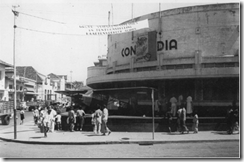
***** to be continued

Thursday, 30 October 2008

The Dutch MPs

The Dutch MPs had been retained by the Japs in their functions for the time being and it was a clever move as it had relieved the Nips themselves of the responsibilities for keeping order in the town.  It speaks for itself that the European, and most probably also the native population appreciated the fact.  Ena and I were to become very friendly with the MP party which had been detailed to look after Dennenlust.  The NCO in charge was a certain Onder Lieutenant Kagee, a fine type of long service military man and we often wondered what became of him.  He was terribly broken up about the Dutch capitulation and told us that he simply could not take it in, that the Dutch Indian Army had ceased to exist.  It had been his whole life, poor chap.

The MPs used to patrol regularly and we never let them pass the house without calling them to come in and have a glass of beer, of which we still had a small stock.  It become the regular custom in the weeks that followed for them to drop in once or twice a day for a chat, a snack and a drink and we were only too glad to be able to do something for them as the rations they were receiving from the Japs were quite insufficient and they were always hungry.

Even in those early days the Japs gave evidence of the muddle headedness of their ways of doing things.  One day these MPs would be armed with revolvers and the next day another Jap would take way all fire arms from them, while on the third day still another Jap would insist on their being armed and issue revolvers and ammunition again.  We accepted this as being due to the general confusion to be expected at this particular time but it was proved indicative of the usual Japanese way of doing things and it will, I think, always remain a mystery to the Western mind how the Japs were able to  accomplish as much as they did.  In all our experience of them no reason or object could be traced in their methods and the proof, in my opinion, that their success was attributable to the mistakes and blunders of others and not to their own organising capabilities, it is to be found in the eventual, chaotic state of all territory which they occupied.  They showed themselves to be past masters in the art of ruining a country in an incredibly short space of time and the mess they made of Java in three and a half years baffles description.  One can only conclude that they realised from the beginning that they had no chance of achieving ultimate victory and therefore determined to do as much harm as they could in the shortest possible time.  It seems the only explanation.

***** to be continued

Wednesday, 29 October 2008

Return to 'Sunny Corner'

About 11 am Sunday, a Dutch MP on a motorcycle came to warn us that 'Sunny Corner' was empty and suggesting that we should return to Dennenlust immediately.  We needed no urging.  In record time, the Hillman was loaded up with the dogs, cats, birds, ourselves and sundry articles of baggage and off we set for home, the faithful Amat following on his bicycle.

Our progress up the  Dennenlust road was in the nature of a triumphal procession.  The news had spread and all the folks in the houses on each side of the road smiling and waving to us, from their verandahs, as we came up the hill.

As soon as we had unloaded the car I set out to Dagoweg 31e again to fetch some remaining items.  Coming down the Dagoweg not far from the imageBorromeus hospital a Dutch MP signaled to me to stop.  When I did so, he informed me that all cars had to be surrendered immediately and that I must get out and leave the Hillman standing at the roadside.

"Have a heart," I said.  "I've just got back my house after being evicted 6 days ago and am bringing my belongings back home," and suggested that he turn a blind eye to the telescope until I had made this one trip.  He was a decent and reasonable chap and agreed, but I had to promise him that I would deliver the car to the Jap authorities at the Technical High School in the Dagoweg the grounds of which were being used as a collecting centre, as soon as I had made the trip.

I got back to Dennenlust in due course with the second load but just as I was leaving again to hand in the Hillman as promised a terrific rainstorm started which continued all afternoon until after dark.  I had strapped my bicycle on to the car as I should have to cycle back, but in such a downpour with a very high wind, I would have been half drowned on the return journey.  I decide, therefore, to deliver the car to the depot early next morning, but when I arrived no Japs were to be seen, although the grounds were full of cars of all description.

The European porter who was still on duty told me that I could put the car there if I liked but I agreed with him that it would be foolish to do so with nobody there to receive it.  He informed me that he had heard that the Japs concerned were to be found in the Ursuline Convent up the road, so I decided to go there and hand over the car as arranged.  But the convent was also void of Japs, so not knowing what to do about the matter and also considering it unwise to continue using the car, I eventually ran it into a garage behind Ena's mother's house and there it remained for some months until the Japanese discovered it in one of their periodical searches and took it away.

'Sunny Corner' was in a bit of a mess after having been occupied by 40 Japanese soldiers for almost a week, but not nearly so bad as might have been expected.  Our carpets particularly had suffered as the Nips had walked over them with their muddy feet and a broad dirty track ran diagonally across the large Chinese carpets in the front room and dining room.  All the furniture had been pushed into corners to achieve sleeping accommodation on the floor and remains of meals and dirty plates were everywhere.  Our lovely little blue and white kitchen with its attractive 'Esse'-Fairy' cooker imagewas a sorry sight.  But actually there was nothing which could not be restored to its former state with time and a lot of elbow grease.

In every room we found bottles of wine and spirits, some empty, many a quarter to half full and a few still unopened.  Outside, at the back, were cases of empty soda water bottles which appeared to have been bought from Penang.  The Japs had certainly done themselves exceedingly well in the liquid refreshment line during their stay.  In fact my first revulsion of feeling at everything Japanese I threw the whole lot out of the house and I am still glad that I did.

The verandah was littered with the remains of what I took to be Japanese emergency rations in the form of some dried and compressed cereals which, with the rain, had swelled into a porridgy unsavoury looking mess.  In our bedroom, which seemed to have been occupied by the Jap officer I found that he had experimented with a few extra safety razors I had and had opened up quite a few packets of spare blades.  We made a clean sweep of everything that had been used by the Japs.

In spite of their having been at pains to impress us that they had kept our belongings intact, it was quite evident that they had literally been through everything although no great damage had been done.  An unused Kodasope 8mm film had been unwound and re-wound and put neatly back into its box, for instance, and traces of their monkey like activities came to light repeatedly during the next few weeks.

Things turned up in the most unexpected places.  One of Ena's bras appeared from her sewing basket.  In taking down a book from one of the bookshelves I got a toothbrush on my head.  Small articles, relegated long ago to the lumber room, were found in cupboards and drawers in the bedroom.  There was strong circumstantial evidence that my kilt and at least one of Ena's evening frocks had been tried on.

All our linen was missing and also one of the heavy curtains from the window in the sitting room, but apart from these items nothing seemed to have been taken.

We had found the Dutch Military Police guarding the house for us on our return and they were most helpful in assisting us to put the house to rights as far as moving back heavy furniture to former positions, etc was concerned and we were most grateful for their help.

***** to be continued